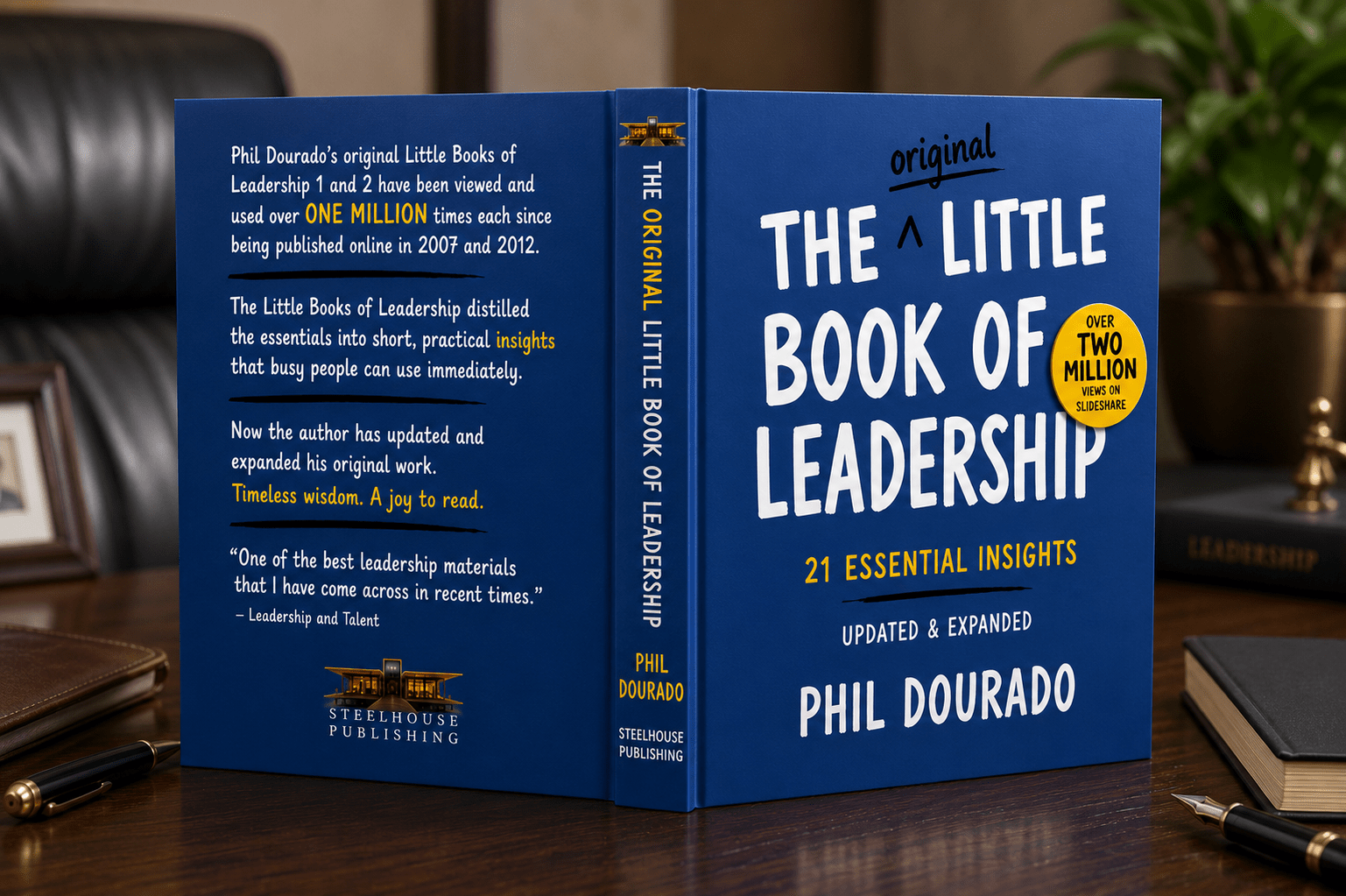
Well, I say new. The (Original) Little Book of Leadership is an updated and expanded version of my Little Books of Leadership 1 and 2 that have garnered over two million views since being published on Slideshare in 2007 and 2012. There are other books called The Little Book of Leadership. But mine came first. Timeless wisdom. A joy to read. Apparently. Leadership is viral. Pass it on.
“Dear Phil, I have just now received the finished books. I am delighted, as are my family. Thank you for your friendship, patience and advice along the way. You turned my turgid prose into written words that make the reader want to turn to the next page. It has been a great experience.” Dr Chris H GP and Musician
I’ve helped fourteen clients write their life stories, acting as their ghostwriter, interviewing and teasing out the story of their life as a compelling read. That’s fourteen people’s lives captured for posterity in book form.
“As an individual who has provided me with guidance, leadership and a true friend, I would sincerely like to thank Phil Dourado, co-writer and editor of both my books. Without him this exercise would have been far less enjoyable and the outcome far less engaging and readable.” Keith T Retired international businessman, golfer, furniture restorer, husband, father, former magistrate, philosophy lover
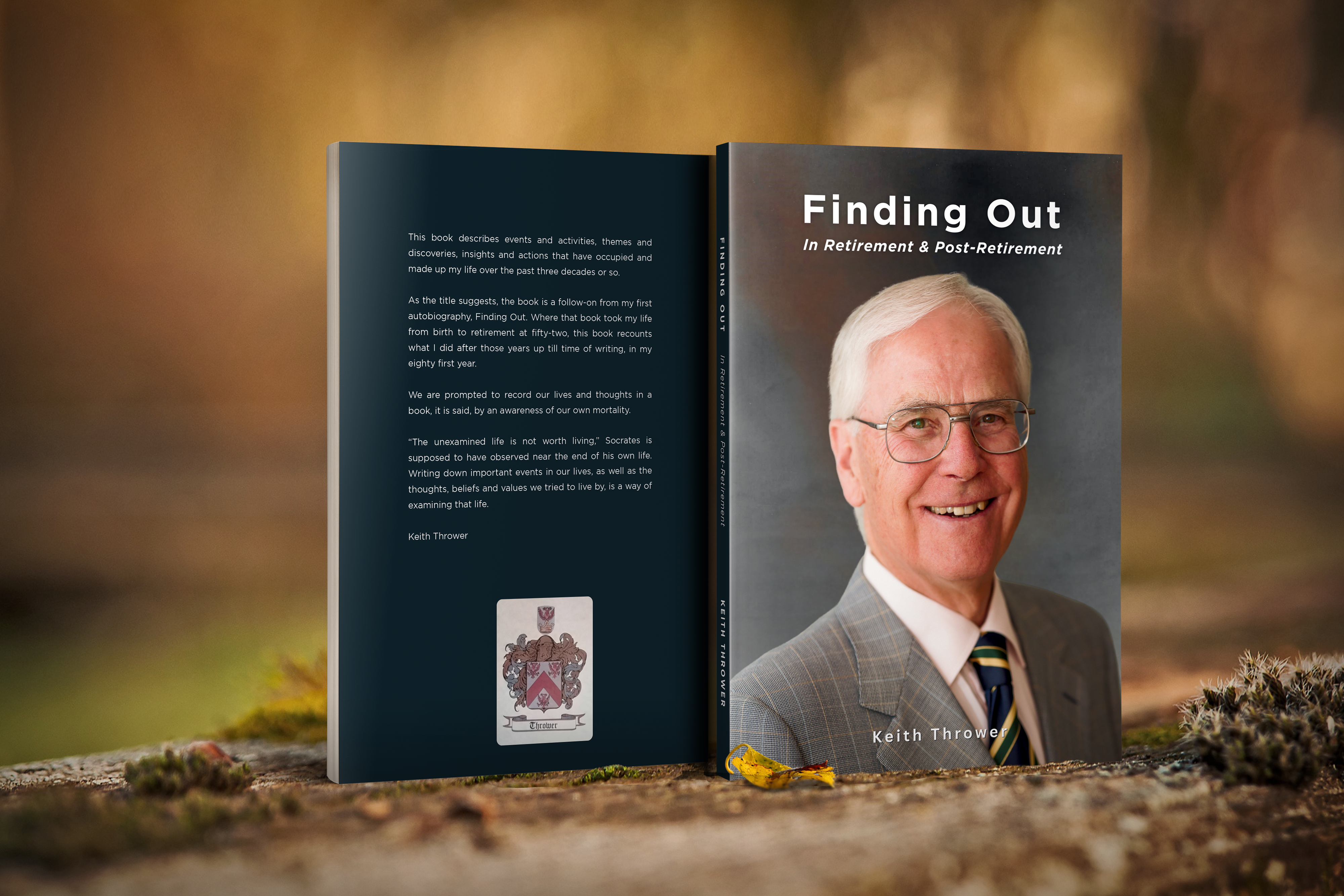
Here’s a recent hardback example:
Whether you want 10 coffee table-quality hard backs for the family and posterity, to capture, celebrate and remember a life well lived, or an autobiography for sale on Amazon, so family members and friends far and wide can buy it if they wish, I can help you with either or both of those services.
What my clients say A few comments from recent clients. If you are interested yourself, contact me via the virtual business card, above:
“Dear Phil, I have just now received the finished books. I am delighted, as are my family. Thank you for your friendship, patience and advice along the way. You turned my turgid prose into written words that makes the reader want to turn to the next page. It has been a great experience.” Dr Chris H GP and Musician
—
“Phil, it was a real pleasure to work with you and couldn’t have done it without you. Just want to say a big thank you for all your help as the book arrived a couple of days ago. It is absolutely brilliant, brings back all the memories and is exactly what I wanted. Will be great to give it to the boys on Christmas Day. Hope they don’t get too emotional once they open the wrapping.” Steve L Businessman, whose book captured the life story of his wife so their children would always remember her
—
“Dear Phil, Now that the book is finished, I want to thank you for being so helpful and patient and for guiding me through the project in such a professional manner. I was so fortunate to have you as my ghostwriter and am extremely happy with the end result.” Audrey B Retired Head Teacher, who loved driving her Alfa Romeos very fast
—
“Thank you for all your help in writing my book, Phil. As I said to you at the time, our interviews were a pleasure. The process felt like therapy, helping me understand and reflect on what I’d gone through, and the resulting writing is outstanding. I am so pleased with it. Thank you again.” Dr Amit B NHS doctor and family man, who used his book to reflect on a life-threatening experience
—
“As an individual who has provided me with guidance, leadership and a true friend, I would sincerely like to thank Phil Dourado, co-writer and editor of both my books. Without him this exercise would have been far less enjoyable and the outcome far less engaging and readable.” Keith T Retired international businessman, golfer, furniture restorer, husband, father, former magistrate, philosophy lover
—
“Phil is a class act. He listens carefully, is genuinely interested, asks all the right questions, does his own research to verify, then comes up with compelling storytelling to bring the true tale to life. He’s a fund of good advice and suggestions as well as being a first-class writer who translates what you want to say onto the page brilliantly. He comes highly recommended if you have a story to tell and want a trusted writer to help you tell it.” Rob P Retired entrepreneur and bowls enthusiast
—
“I can’t recommend Phil enough. His understanding and empathy were extraordinary and he became a real friend in the interview process. He helped me navigate difficult material and find exactly the right words to convey my story with humour, nuance and warmth. Writing my book with him was a wonderful experience and I am so pleased with the outcome. He helped me find my voice.” Yvonne W NHS Executive Director, whose book captured how to lead a highly successful life with Type 2 diabetes
I remember a hotel general manager telling me how careful you have to be when assessing emotions at work. A member of his staff answered a weekly “How did you feel at work this week?” email question with one word: “Sad”. He went to find her and asked what was wrong with work, what he could do to help. “Nothing,” she said, puzzled. “Then why do you say you are sad at work?” he asked. “Because my mother just died,” she said.
I did some work ages ago with Robert Levering, founder of theGreat Place to Work Institute, helping him identify UK employers who might be eligible for that description, before he launched the Institute in the UK (he’d come over from San Francisco, where it was well-established already).
I like that phrase ‘great place to work’ as something to aim for in the work experience. I had reservations about its successor ‘happiness’: I prefer ‘great’ as the employee can define what that means, whereas identifying one emotional state and saying everyone needs to be in that state else there is something wrong seems too prescriptive to me.
Many of us aren’t naturally happy people anyway. We’re fine, though. We may be laconic, idealistic, perfectionist, serious-minded realists. Doesn’t mean we lack a sense of humour or can’t find work great and fulfilling, creative and liberating, uplifting, all that good stuff, nor that we aren’t supportive of others, helpful, generous in spirit to colleagues and customers, with a smile on our face, not a scowl. But, we don’t go around happy as a natural state. Where do we fit into the happy workplace? Do we inhibit its development? Are we unwanted?
The emergence of ‘joy’, which came along more recently as something to aim for at work, has tipped me over the edge, as it seems to be language inflation – the upper end of happiness. I think both those emotions (happiness and its peak, joy) are, by definition, high points, experienced in moments. Aiming to make them a permastate during the work day seems unachievable to me.
I’d reserve joy for watching a child being born, not having a fulfilling and productive day at work. It just doesn’t quite do it for me. And, in a world of quiet resignation, this hyping up of work as an ultimate (joy is an ultimate, no?) experience increasingly seems tone deaf.
On the other hand …
In among all the ‘bowl oranges at plastic water bottles’ (Harvard University’s ‘morejoy’ resources page ) and similar stuff you find when you Google ‘joy at work’, I came across this, from W. Edwards Deming, father of Statistical Process Control (SPC may not sound joyful, but it liberated, for example, Harley Davidson employees to say they love their work by putting them in charge of it):
“Management’s overall aim should be to create a system in which everybody may take joy in his work.” Dr. W. Edwards Deming
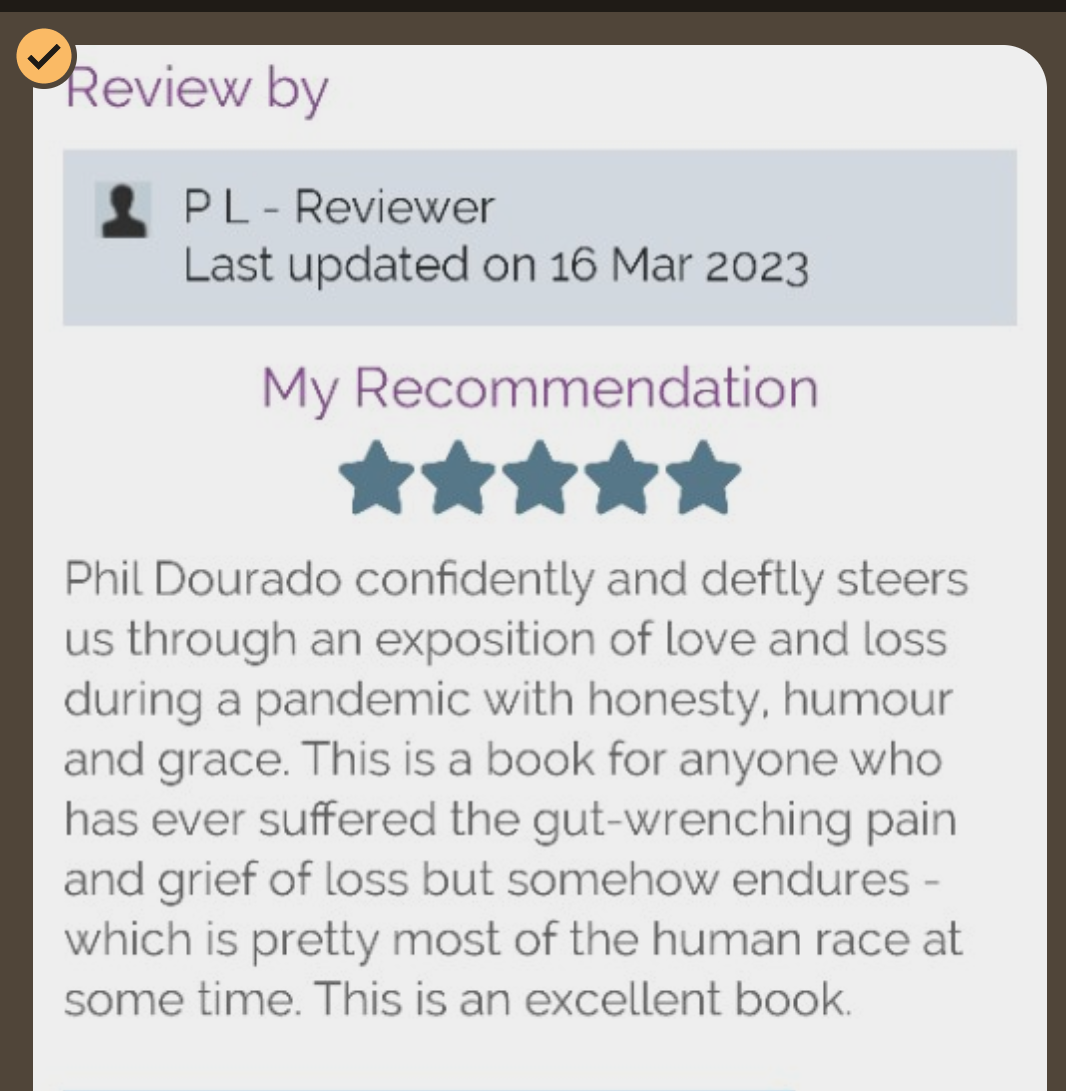
“This accomplished experimental novel centers on loss, connection, and trying to heal in a pandemic. Dourado manages to balance tragedy and comedy in this intriguing debut that reimagines the novel in the context of Covid-19.”
– Publishers’ Weekly Book Life Supplement, November, 2021
“A moving and funny memoir of love & loss in a time of turmoil.”
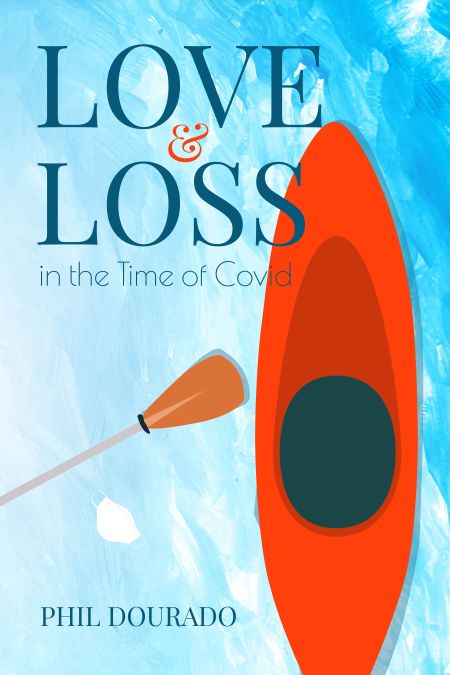
Front cover.
My new book, published by Steelhouse Publishing, is available as a paperback and a Kindle eBook on these links:
This story follows the intimate journey of Matthew, who has lost three important people in his life during Covid, in succession, and how he navigates how to cope with his loss and grief. I found his journey along the Thames to be so symbolic – from putting the pieces of the kayak together to the navigation down the River, in the water – perhaps a search for rebirth. Having sought solace and peace in nature during lockdown (and still now), I could understand why his early morning time, drifting along, breathing in fresh air, were key to his search for healing.
The book offered humor where it was needed to give us some comic relief within a heavy subject matter. I found this book to be easily relatable, having lost friends and loved ones during the pandemic (and at other times too). Being separated from my mom for 6 months as her apartment building was in total lockdown, I could relate to his concerns for his own mother. Forced to wave to my mother from the sidewalk up to her 8th floor window was heartwrenching, but necessary for her health and protection. The author writes in an intimate, honest tone that I appreciated. There is no sugar coating to the pain from loss.
I totally understood how the main character used books, films, nature, videos, Ted Talks, science, grief counsellors, journals and articles written by others who have suffered grief – any avenue he could – to help him in his pain of loss and help him find a way forward to light and hope.
We live in a different world now – still in Zoom for many things where we used to have human contact, and finding ways to accept this way of life and find some positivity in it. The daily news lead off story is still about Covid and we can either fall into the darkness of it or choose light and hope for a better future.
I so appreciate that this book was written in real time. I loved this book.
TOP REVIEWS UNITED KINGDOM
Mrs T 5.0 out of 5 stars
Can’t put this down 5*
Reviewed in the United Kingdom on September 5, 2021
I know it’s a cliche, but I can’t put this book down. I’m three-quarters of the way through. My dog is staring at me with his legs crossed, needing his walk. My son and his family are due for Sunday lunch. So, I have to put it down and get up for both of those. But, then I’m really looking forward to getting back into it. The grief theme and how the main character tries to work through it when he loses several people at once makes complete sense to us. My husband lost both his parents very close together and, when that happens, you haven’t been able to grieve full circle for one before you start again. It just all comes at you at once. Intensely moving and surprisingly funny book.
Barbara 5.0 out of 5 stars
An unforgettable, extraordinary book.
Reviewed in the United Kingdom on September 8, 2021
Superbly written, original, intensely personal, moving, funny. One of the most evocative, extraordinary books I’ve ever read. We’re inside the central character Matthew’s head as he encounters, remembers and confronts his experiences of grief, loss and powerful love. I can’t recommend this book enough. It’s also great if you read in bitesize chunks – if you can bear to put it down, or simply have to, such as during a commute to work. But believe me, you’ll actually long for the journey time because every chapter sings. Unforgettable.
READ AN EXCERPT
You can read an excerpt by going to the book’s page on this link Publishers’ Weekly Booklife Site and clicking on the ‘Download excerpt‘ button.
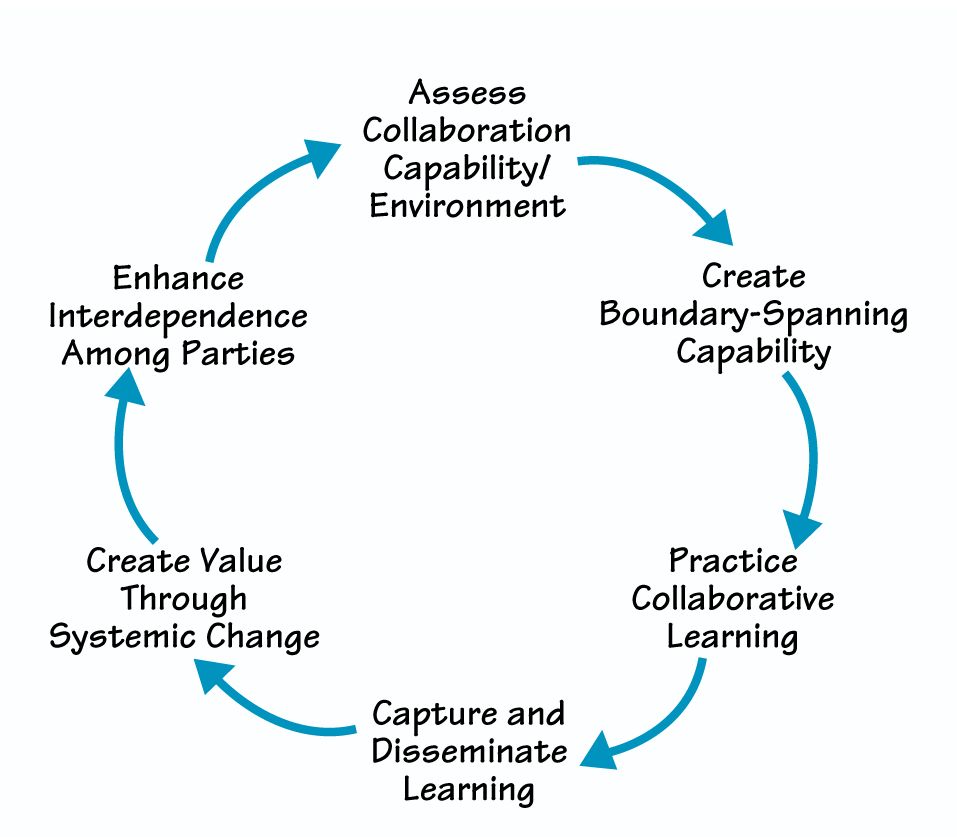
That’s a very useful article from The Systems Thinker on the needed steps for establishing collaborative learning in your organisation.
In our in-house leadership learning networks, the interactions of those in the collaborative learning community can lead to organisation-wide change. One-off experiments and policies that were hidden become company standards (such as how Lissy changed IHG…).
But in order to get to that point, the organisation has to establish an overall collaborative learning culture.
The one point I would contest with the write-up is on the ‘bridge’ to establishing collaborative learning beyond an individual level, via creating ‘internal learning groups’. The idea here being that each group focuses on achieving business results while building collaborative capability, as they are drawn from various divisions and levels within the company (the example given in the essay is a chemical company as one group, communicating with a lab as the other).
I get the idea… sort of. It feels like a natural expansion to go from ‘individual’ to ‘group’ before ‘organisation’.
But there are a couple of dangers to this approach
Our experience of having run a Leadership Development community for ten years is that you SHOULDN’T start with small groups in some cases, but start with an organisation-wide learning network focused on a particular subject – in our case, leadership – then see if there is the appetite for the smaller groups once you have helped establish the overall collaborative learning culture.
Because there is a danger that right from the start you dissipate the momentum or energy by focussing it within particular groups rather than having a cross-organisation culture you are developing that is a common experience for all of the learning network members.
However, our experience isn’t the only experience to draw on. Others may have started with existing small groups in organisations and brought them together within a larger network.
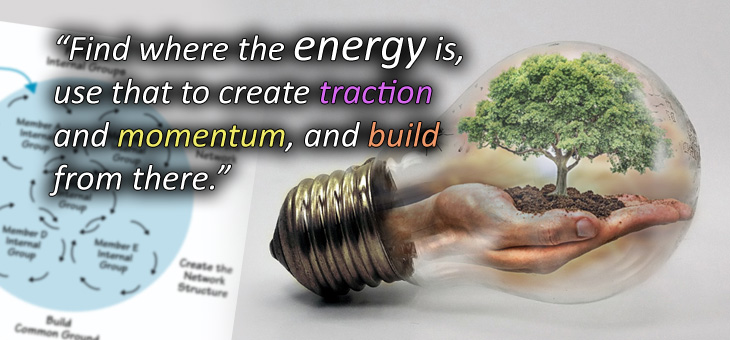
Find where the energy is, use that to create traction and momentum and build from there
That’s the principle of success. If that energy already exists in small groups, draw on that first.
We are about to start work with a client where some of its employees, in the absence of an online collaborative work environment, have set up ‘unofficial’ Yammer groups to share learning on different areas of expertise, as small communities of practice.
We are about to co-build with that organisation an ‘official’ company-wide Leadership Learning Network so they can begin to establish collaborative leadership. The digital community will become the organisation’s Community of Practice for leadership.
But, we can’t ignore the existence of the unofficial groups. So, we are looking to co-opt them – find out what they use the groups for and somehow make them sub-groups of our overall network, or offer a more user-friendly and more useful learning community than Yammer so that they might want to migrate over to the main community, taking their group with them.
A Challenge or Opportunity emerges in the work itself
Learning from that work is shared…
… to be Tested and further Refined by others in the organisation…
… which leads to more individuals approaching work challenges as potential learning experiences, which leads to more sharing, more refining… And so on.
Emergent Learning is the most natural way that we learn as humans…
Our brains are built for it. We thrive on social connections and have far better retention for learning once we put it into practise. It’s how you are learning every day whether you realise it or not.
Which means it’s mindboggling that modern Leadership Development has not caught onto that framework yet.
Why? I can only imagine because it seems almost too organic. It’s impossible for most organisations to picture how Emergent Learning can become a recurring, manageable practise. Seemingly, it requires giving up control over what knowledge will be taught.
But what is really being giving up is an assumption of control. These organisations have to give up the assumption that their Leadership Development already knows everything that their leaders need to know.
It’s an archaic mindset. We’ve all been students, so we all assume that the best way to learn is from one ‘teacher’, who must surely know everything important that their students will ever need to know.
We NEVER assume that we know everything
We don’t assume what knowledge is out there in the organisation. In our Emergent Leadership Development communities, our role is not the ‘teacher’. EVERYONE is a teacher and a student at all times.
Successful Leadership Development looks more like a Curator. The one who facilitates this emergent learning, opens the floor, spots potential wisdom and brings it to the foreground.
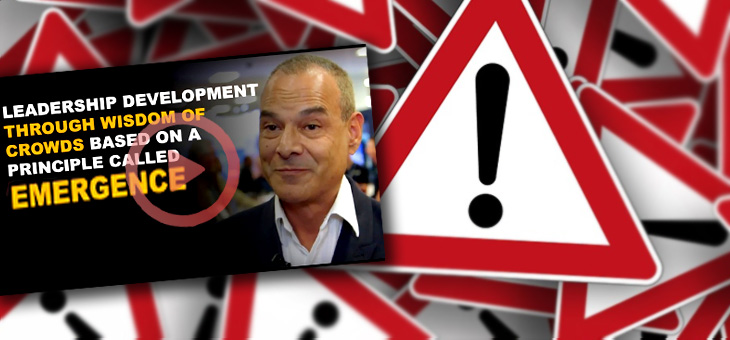
Here’s me talking on this subject if you want to dive more deeply into it. I have more than 10 years experience curating award-winning online Leadership Development communities built around Emergence and the Wisdom of Crowds.
“I’ve led and commanded men and women on military operations around the world and never seen problems as challenging or leadership situations as complex as those faced in the NHS on a daily basis.”
Stephen Hart, in charge of leadership development for Health Education England, has operated at senior level in both the military and the health service. His last role in the military before joining the NHS was Head of Command Leadership and Management for the Army Division at the Defence Academy of the United Kingdom.
This is one anonymous Health System’s vision for healthcare quality:
“Our health system is world-leading in delivering the best outcomes across all six dimensions of quality.
Our healthcare system is just,
engages patients and families,
and is relentlessly committed to improvement.”
Yes, it’s the use of the present tense to describe a desired future reality.
So many vision statements do this – express a ‘wish’ as an ‘is’.
What that does to people working within that system is embed the ‘is’ as … an ‘is’ !! It becomes, in a subconscious sense, their current reality.
It’s Martin Seligman’s positive thinking in all its unrefined, undeveloped ideal form:
Imagine the reality you want. Picture and describe and talk about it as real. Then move your existing reality to become that.
The problem is that more recent research into how to create a desired future state shows that once you talk about it as if it exists, you fool your brain and the brain of everyone else who works within that system into thinking the desired state DOES exist.
Like you, I’m sure, I’ve worked in large organisations with smart people who can’t see the improvement needs in their own practices because of this sense of the vision and values that have been ‘socialised’ in the organisation.
Any voice of criticism that suggests you aren’t living them is seen as disloyal. Hence the ‘whistleblower’ problem across all healthcare systems across the world.
This Health System’s report on its vision (from 2015) goes on as follows
Having set out the vision and principles underlying a quality system, the committee working on this project then delved more deeply into how to implement such a system in our health system.
Released in April, this report acknowledges that our province still does not have a high quality healthcare system for everybody, with the health system working well only for some people, with some conditions, treated some of the time.
The report sets out a number of recommendations for organizations in how to better understand quality healthcare, and how to deliver that care and foster a culture of quality.
Talking about quality across all six dimensions has to involve all stakeholders in the system – from governments, to hospitals and health authorities, to health care providers, patients and caregivers.
These conversations are essential if we are to move forward and make quality care a reality for everybody in the province.
Great. All true. But all totally undermined by the use of the present tense in that vision statement. Which sabotages the thinking of all involved right from the start.
That’s just one example of how leadership and quality improvement in healthcare and other systems needs to keep up with advances in the psychology of work and not get stuck in old ‘vision’ thinking that is no longer fit for purpose.
Leadership Conversations
The ‘leadership conversations’ talked about above have to be honest and reflect reality – ‘brutally confront existing reality’ (Collins, Bossidy etc) while creating and sustaining a sense of realistic optimism that “we can do this” by sharing small-scale real examples of changes happening at all levels.
That’s what the online communities (that my team builds) do: enable real conversations that “prevent a BS culture of management speak from being the dominant and only acceptable mode of conversation” (in the words of one of the leaders in one of our communities run for one of the largest companies in the world).
A new article by Phil Dourado on patient-led care, a well-discussed but rarely practised tenet of Healthcare Leadership.
What should patient-led care look like in real, practical terms? Here are 3 examples in this 60-second article…
“He feels that he leads the shaping of his own life, rather than having his life led by the illness, mediated by the consultant.”
What we all have in common is the need to lead our own lives.
Patient-led care changes the view of what a ‘successful outcome’ for long-term treatment will look like, letting the patient or their representative describe their view of success. Then the health and social care package is shaped around them to best achieve that.
It empowers the patient, and improves their relationships with the staff by breaking the staff’s assumptions of how the average case works.
“No-one is average. Constructing a care package and expectations from the ‘median’ or ‘mean’ or some other aggregation that leads to ‘likely outcomes’, pushes those likely outcomes to the average; often down from the outcomes you can achieve if you are led by the patient.”

 in charge of leadership development for Health Education England, has operated at senior level in both the military and the health service. His last role in the military before joining the NHS was Head of Command Leadership and Management for the Army Division at the Defence Academy of the United Kingdom.


 LinkedIn